

July 22, 2026
Can clothes go in the recycling bin?
Most clothes do not belong in curbside recycling. Learn what to donate, drop off, or throw away after a closet cleanout.
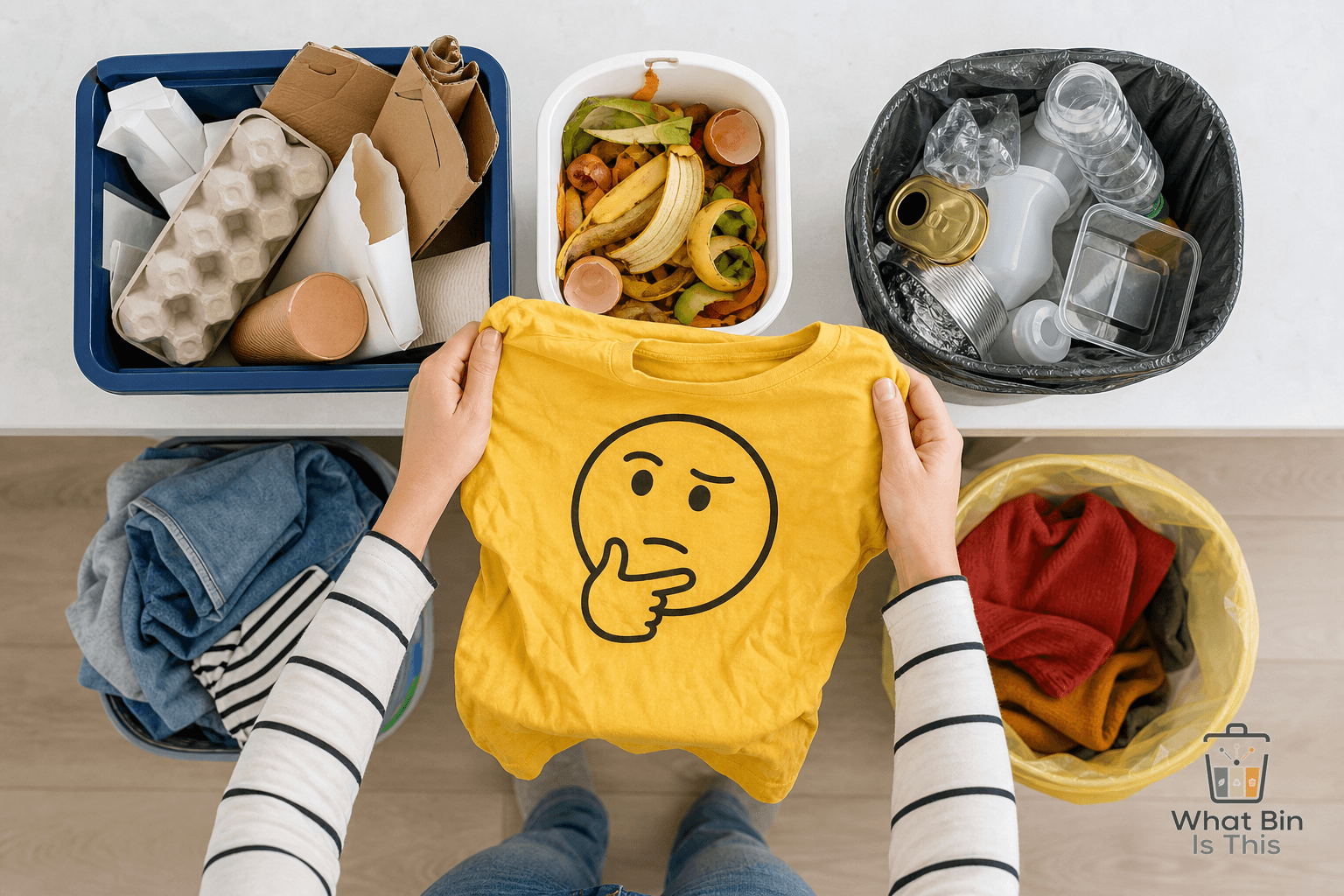
A closet cleanout creates a weird pile fast. One shirt is fine but boring. One sock has no partner. One towel has crossed into garage rag territory. Then the blue recycling bin starts looking tempting.
Do not do it.
Clothes feel recyclable because they are useful material, but curbside recycling is not built for loose fabric. The better answer depends on condition: wearable, clean but damaged, or too gross to hand off to anyone.
Direct answer
No, clothes should not go in your regular curbside recycling bin in most places.
Your blue bin is usually meant for things like bottles, cans, paper, and cardboard. Clothing is a textile. It can wrap around sorting equipment, travel through the system as contamination, and make a mess for facilities that are not set up to process fabric.
Use this basic order:
- Donate, sell, or give away clothing that is clean and wearable.
- Use a textile recycling drop-off for clean clothing, sheets, towels, and fabric items that are too worn to donate, if your area has one.
- Trash items that are wet, moldy, oily, chemically contaminated, or covered in bodily fluids.
- Keep all clothing out of the curbside recycling bin unless your local program specifically says otherwise.
That last part matters. Some places have textile collection, but it is usually separate from normal recycling.
Why the answer is not obvious
A shirt is not like a glass bottle or an aluminum can. It is often a mix of cotton, polyester, spandex, buttons, zippers, elastic, thread, printed graphics, tags, and sometimes coatings. Even one simple hoodie can be several materials stitched into one object.
That does not mean clothing has no second life. It means it needs the right channel.
Curbside recycling systems are designed around sorting rigid containers and flat paper products. Fabric behaves badly in that setup. It bends, tangles, absorbs moisture, hides inside bags, and gets wrapped around machinery. Workers and equipment then have to deal with the mystery laundry nobody asked for.
This is the same basic problem as other recycling contamination: the item may be reusable somewhere, but it does not belong in that specific bin. If you want the broader rule, read What counts as recycling contamination?.
Common mistakes
The biggest mistake is tossing a bag of clothes into the recycling cart and thinking, close enough. It is not close enough. Bagged items are often treated as trash or contamination because sorting facilities cannot safely inspect every mystery bag.
Another mistake is donating anything with fabric on it. Donation is great for wearable clothes. It is not a magic portal for ruined stuff. If a shirt is clean but stained or torn, a textile drop-off may still want it. If it smells like mildew, has pest damage, is soaked with motor oil, or has been sitting wet in a basement, it probably belongs in the trash.
People also mix closet accessories into the same pile. Hangers, garment bags, shoe boxes, broken laundry baskets, and plastic packaging all have different rules. Do not leave hangers attached to clothing unless the donation site asks for them. For that side quest, see Can you recycle plastic hangers?.
Shoes are another trap. Many shoe donation and takeback programs exist, but shoes generally do not go in curbside recycling. They are mixed materials, often glued together, and not sorted like bottles or cans.
And yes, socks count. Clean wearable socks can be donated if the organization accepts them. Clean worn out socks may be accepted by some textile recyclers. Nasty socks go in the trash. Life is short.
Simple closet cleanout checklist
Before you choose a bin, sort the pile like this:
- Is it clean and dry?
- Is it wearable as is?
- Would you hand it to another person without apologizing?
- If not wearable, is it still clean fabric?
- Does a local textile drop-off accept damaged clothing or fabric scraps?
- Are hangers, bags, tags, and packaging removed?
- Is anything wet, moldy, oily, or contaminated?
Quick rule:
- Clean and wearable: donate, sell, or give away.
- Clean but damaged: textile drop-off if accepted locally.
- Wet, moldy, oily, or gross: trash.
- Any clothing in the regular recycling bin: usually no.
Local-rule caveat
Textile rules vary a lot by city, hauler, nonprofit, and drop-off operator. One bin may accept clean damaged clothes for fiber recovery. Another may only want wearable clothing. Some take shoes and belts. Some do not. Some accept towels and sheets. Some only want clothing.
Read the label on the bin or the local program page before dropping off a huge bag. If the bin is full, do not leave bags outside. Once clothing gets rained on, ripped open, or dragged around a parking lot, it can become trash even if it started as a useful donation.
Also watch for special curbside textile programs. If your city offers one, it is usually a separate bag, pickup request, or scheduled collection. That is different from putting clothes into the regular recycling cart.
Practical takeaway
Clothes do not belong in normal curbside recycling. Treat them as a separate category.
If they are clean and wearable, give them another use. If they are clean but worn out, look for a textile drop-off that accepts damaged fabric. If they are wet, moldy, oily, or genuinely gross, trash them without making it a moral puzzle.
The blue bin is not a closet cleanout shortcut. It is a sorting system, and loose fabric is exactly the kind of thing that makes it worse.
Not sure about a specific item from the pile? Search it at What Bin Is This before you turn your laundry basket into a recycling experiment.